Showing posts with label The Unconscious. Show all posts

Wednesday, 14 December 2022

Arcanum Paradoxa

Ostensibly the forerunner of modern chemistry and usually considered a ‘pseudo-science’ Alchemy first emerged in Egypt during the Hellenistic period. At roughly the same time, a form of Alchemy associated with medicinal aspects of Taoism emerged in China.
The general objective of Alchemy was the creation, through transmutation, of some type of marvellous, quintessential substance, often considered a miraculous elixir, a panacea, for curing all ills, bestowing immortality or spiritual enlightenment.
Known as the art of Khemeia, Alchemy had its theoretical basis in metallurgy, Zoroastrianism, Stoic pantheism and Aristotle’s Four Element theory of matter. The first significant exponent of Alchemy was Bolos ‘Democritus’ of Mendes (circa 200BC) whose treatise, Physika et Mystica, dealt with dyeing and colouring, the creation of gems, silver, and the transmutation of metals, specifically the transmutation of lead or iron, into gold. One tenet of alchemical doctrine was that the prime matter (prima materia) or raw material of transmutation comprised the least valued, most disregarded, of all the elements. Common or ‘despised’ material, both ‘contemptible and precious’, formed the basis of The Work, the opus alchymicum.

There is a secret stone, hidden in a deep well, worthless and rejected, concealed in dung and filth... (Johann Daniel Mylius: Philosophia Reformata, 1622)

Khemeia did not flourish during the Roman era, as various Emperors, notably Diocletian, feared that the transmutation of base metals into gold would undermine economic stability. A notable exponent of the Work in later times was the mystic Zosimos of Panopolis (Akhmim) whose Hermetic Encyclopaedia (a 28 volume compilation of existing and original texts) is dated 300CE. However, as Khemeia was considered ‘pagan learning’, much ancient knowledge of the art was lost during the Christian riots in Alexandria in 400CE.
The Arabs revived interest in Khemeia in the seventh century, as part of a general fascination for Greek science and thought. In the Arabic language the word ‘Khemeia’ became ‘al-kimiya’ and it was this form of the word that became the European term ‘alchemy’.
To define Alchemy as a pseudo-scientific forerunner of modern, scientific chemistry is an oversimplification. From the earliest times Khemeia comprised a resonant, symbolic framework for imaginative speculation. This speculative aspect of the art soon overshadowed its ‘practical’ metallurgical objectives, leading to a well-deserved aura of obscurantism and uncertain interpretation.
In the period between Bolos and Zosimos, Holmyard observes, ‘alchemical speculation ran riot’ as diverse practitioners created a complex body of doctrine, ascribing symbolic meanings to the sequence of metallic colour changes, incorporating all contemporary strands of speculative thought into alchemical theory, including Egyptian magic, Greek philosophy, Gnosticism, Neo-Platonism, Babylonian astrology, Christian theology and pagan mythology.
Works of Khemeia were invariably couched in an ‘enigmatical and allusive language’ and often ascribed to semi-legendary or mythical authors such as Hermes Trismegistus, Plato, Moses, Miriam (the legendary sister of Moses), Agathodaimon, Theophrastus, Ostanes, Cleopatra and the goddess Isis. Thus, almost any contemporary, metaphysical speculation was assimilated into eclectic alchemical thinking: many sayings, stories and myths were endowed with alchemical interpretation, or incorporated into the Hermetic worldview.
By the Byzantine era Stephanos of Alexandria, a philosopher, mathematician and astronomer who flourished during the reign of the Emperor Herakleios I (610-641), had come to view Khemeia as primarily a ‘mental process’. Following F. Sherwood Taylor, E. J. Holmyard quotes Stephanos’ denigration of practical alchemy as a "burden of weariness", observing that by this time (the seventh century) alchemy had ‘very largely become a theme for rhetorical, poetical and religious compositions, and the mere physical transmutation of base metals into gold was used as symbol for man’s regeneration and transformation to a nobler and more spiritual state’.
So, well before the rise of medieval European alchemy, the tendency to regard The Work as an internalised, psychic process or phenomenon was established. Khemeia could easily be dissociated from physical chemistry and metallurgy and defined as some kind of ‘spiritual’ discipline. Now, the objective was not the transmutation of external phenomena, but the transmutation of the adept himself, and this transformative process was expressed in an obscure, introspective, mythic vocabulary of symbols and complex terminology.
In modern times a fascination with alchemy as an internalised, mental process has been continued by the Surrealists and the psychologist Carl Gustav Jung (1875-1961). During the inter-war years and roughly around the same time both Jung and the Surrealists claimed Alchemy as significant in their respective investigations:

…let us not lose sight of the fact that the idea of Surrealism aims quite simply at the total recovery of our psychic force by a means which is nothing other than the dizzying descent into ourselves, the systematic illumination of hidden places and the progressive darkening of other places, the perpetual excursion into the midst of forbidden territory… (Second Manifesto of Surrealism, 1930)

Jung and the Surrealists (particularly Andre Breton and Max Ernst) were operating against the backdrop of a revival of interest in alchemical symbolism in France and Germany. The works of Zosimos had been translated into French and published by Berthelot and Ruelle in 1887-1888. Herbert Silberer, who proposed a connection between alchemical thought and modern psychology, had anticipated Jung’s researches.
In France the Surrealists were influenced the alchemical novels of Francois Jolivet-Castelot and the esoteric writings of Fulcanelli and Grillot de Givry. De Givry drew attention to the hermetic influences at work in the art of painters like Bosch, Bruegel, Cranach and Baldung. Initially Andre Breton saw alchemical thought as a way of re-investing poetic language with a sense of mystery: this soon evolved into a more ambitious proposition, the deployment of an ‘alchemy of language’ to transform consciousness, and by transforming consciousness, change life.
On the other hand Jung’s interest in alchemy was triggered by an ancient Taoist text called The Secret of the Golden Flower translated by Richard Wilhelm and for which he wrote a commentary in 1929. As a result of this work he was motivated to research Western Alchemy, which he subsequently defined as ‘the historical counterpart to my psychology of the unconscious’, and a bridge between Gnosticism and the modern world.
The culmination of these explorations was Jung’s attempt to correlate the ‘transpersonal’ element of his psychological paradigm with modern physics. The ultimate acausal reality or, to use the medieval term, unus mundus, forming the underlying transformative matrix of alchemical processes, can be understood, he argued, as simultaneously both psychic and material. This underlying unus mundus is both the indeterminate universe of psychic symbols and the pre-geometric, ‘implicate order’ of high-energy physics.
At the heart of Jung’s Analytical Psychology is the process of Individuation or self-becoming. Individuation is a non-linear, centralizing developmental process culminating in an enhanced synthesis of the conscious and the unconscious spheres. This synthesis also incorporates a paradoxical harmonisation of contradictory elements, a union of opposites – including, for example, the masculine and feminine principles, the animus and anima – correlating with the alchemical coniunctio as symbolised by the hermaphrodite or androgyny.
Jung felt that elucidation of the opus alchymicum would shed light on the symbolic structure of the Individuation process, because the alchemist’s hope of creating philosophical gold was only a partial illusion: ‘for the rest it corresponded to certain psychic facts that are of great importance in the psychology of the unconscious.’
If the alchemists projected the process of Individuation into the phenomena of chemical change, then the same is true for the poet who, likewise, by a synthesis of automatism and active imagination, projects the same process into the phenomena of poetic (artistic) creation. He or she initiates a transmutation of the ‘prime matter’ of language into the aesthetic ‘gold’ of poetry.
Part of this process is a sustained regression into the sphere of the unconscious (the ‘dizzying descent into ourselves’ mentioned in the Second Manifesto) during which imprints of the individual’s psychological and biological development are uncovered in symbolic form. Thus, the alchemical process, by engaging with the Individuation process, establishes a psychobiological frame of reference for both psychological development and imaginative, poetic creativity (‘inspiration’).
Alchemy, viewed from the Jungian perspective, can be seen as a quest for inner psychic unity and wholeness (actualisation) achieved through a non-rational mode of self-knowledge. However identification of poetry (or perhaps the poem itself) with the alchemical arcanum paradoxa and defining poetic inspiration in the context of a psychobiological, existential substrate, highlights a conflict with conventional ideas tending to categorise writing and/or poetry, as ‘literature’.
Academic and other definitions of poetry as ‘literature’ displace the poetic act of imaginative creation from the interior psychobiological universe to the external world of cultural-linguistic structures where the preferred paradigm is communicative. Furthermore, the current ‘postmodernist’ cultural-linguistic aesthetic model presupposes that everything depends upon language and linguistics to the extent that ‘being’ itself becomes literally indefinable in non-semiotic, extra-linguistic terms. This inevitably inhibits understanding of artistic creativity as in innate psychoactive phenomenon effectively blocking access to sources of inspiration in the indeterminate quantum vacuum of the unus mundus.
The raison d’etre of the ‘literary’ paradigm is communication. In contradistinction, the raison d’etre of the ‘alchemical-surreal’ paradigm is transformation: transformation energised by inspiration, where ‘inspiration’ is defined in terms of psychic energy. In this paradigm of transformation the Jungian valuation of symbols (distinguished from ‘signs’) as ambiguous emanations of non-linguistic or extra-linguistic or even pre-linguistic being is a key factor.
For Jung the psychic presence of symbols (including ‘archetypal’ symbols) is always experienced as ‘numinous’, a categorical term he borrowed from the Kantian-Friesian religious thinker Rudolf Otto (1869-1937). Otto was seeking to extend or deepen the epistemological scheme of his predecessor Jakob Friedrich Fries. This scheme included the notion of Ahndung, a German term which can be translated as ‘aesthetic sense’. Otto expanded the meaning of Ahndung ‘beyond the merely aesthetic’ by introducing the category of ‘numinosity’, the alleged quality of the sacred.
Otto argued that numinosity is the prime characteristic of the collective experience underlying all religions. This experience can involve a sense of overwhelming power, the mysterium tremendum. The mysterium stands as the first cause of all ‘religious awe’, and, in certain respects, if one follows Jung in the matter, accounts for the sense of power and autonomy apparently exhibited by unconscious contents and symbols.
The association of archetypal symbolism with cross-cultural mythic imagery on the one hand, and Otto’s numinosity concept on the other, was one way that Jung, through his writings and researches, endowed psychological processes such as Individuation with ‘spiritual’ qualities. Part of the attraction of Jungian psychology is his overt identification of self-becoming, or personality formation, with the model of the spiritual quest, articulated through an all-pervasive symbolism shared with the alchemical magnum opus, other mystical belief systems or even mainstream theological precepts. As Anthony Storr explains, Jung was able to do this because he identified the integrated Self with an archetypal symbol of totality identical with the underlying reality of Judaeo-Christian monotheism, the imago Dei.
If the raw material of poetry is language, the essence of poetic practice is active imagination or artistic creativity. It is inevitable that imaginative creativity, in pursuit of inspiration, will engage with that innate process of psychological integration Jung called Individuation. From this perspective the poem may appear as a by-product of the process. For the poet, as for the alchemist, the psycho-activity of inspiration arising from the process of self-becoming is the prime factor. It is this psycho-active effect which dissolves the barriers between the conscious and the unconscious, exposing the subject to the autonomous ‘power’ of symbolic otherness, enhancing creative capability.
For many this dissolution is most satisfactorily defined as an ‘archetypal’, visionary, even mystical, experience. Indeed, for some, even the most wilfully mundane or blatantly secular poems can still radiate, however feebly, an aura of the ‘numinous’, investing the text with all the fascination of an alien artefact.
Grounding poetic practice in a fundamental, psychobiological, ontological matrix de-emphasises, even dissociates, ‘pure poetry’ from the cultural-linguistic epiphenomenal ‘foreground’ superstructure of modern ‘literary’ discourse. It is also the case that, contrary to Jung’s position, pro-active engagement with the principium individuationis from an aesthetic perspective may not accord with traditional ‘religious’ paradigms of human perfectibility or divine purpose.
Thus, the alchemical process of inner purification may well amount to a Promethean affront to doctrines of redemption and predestination. Then, the poet, like the alchemist of old, may stand accused of Faustian occultism – or even the heresy of the Free Spirit, interestingly defined by Vaneigem as ‘an alchemy of individual fulfilment’. The declaration of intent in the Second Manifesto of Surrealism to attain the ‘total recovery of our psychic force’ through a ‘systematic illumination of hidden places’ and excursions into ‘forbidden territory’ must be understood in the context of Romantic metaphysical revolt in the tradition of Miltonic Satanism, Byron and Sade. It is not an affirmation of the ‘spiritual quest’, or the unio mystica described as the supreme desideratum by Jung and other exponents of perennial, pan-religious syncretism.
Furthermore Jung’s identification of the integrated Self with any ‘divine’ reality or purpose is open to question in the post-religious context that is the present evolutionary situation of society. Primordial being may exert or radiate a ‘numinous’ attraction of otherness, or the subject may experience such an inspirational effect. It does not follow that experience of this effect is experience of the ‘sacred’. This is true, even if the effect or experience can be shown to be the result of a quasi-objective incursion of, or from, the unus mundus. Only those predisposed, perhaps by cultural conditioning, to a totalising ‘religious’ reading of fundamental experiences can promote such an interpretation without fear of contradiction. Again, if the raw matter of the procedure comprises the least valued, most disregarded, of all the elements, such common or ‘despised’ material. Stuff ‘of no price or value’ (Dyas Chemica Tripartita) will also form the basis of the poet’s Work. Such poetic work is unlikely to meet with approval from the custodians of cultural probity, the proponents of canonical, high-minded artistic or literary greatness.
Is the true poet an exceptional individual?
If the answer is yes, then poetry will reflect the compulsion of such individuals to seek their own path and forge their own identity through an oracular, alchemical poetry, which, like the ancient works of Khemeia, may well appear enigmatical and allusive to the uninitiated.
Digital art: Inner Alchemy III, 2001
Arcanum Paradoxa was published by Atlantean Publishing in The Monomyth Supplement 44, January 2009
Hermetic Art Gnostic Alchemy Of The Imagination (1985) on The Alchemy WebsiteOstensibly the forerunner of modern chemistry and usually considered a ‘pseudo-science’ Alchemy first emerged in Egypt during the Hellenistic period. At roughly the same time, a form of Alchemy associated with medicinal aspects of Taoism emerged in China.
The general objective of Alchemy was the creation, through transmutation, of some type of marvellous, quintessential substance, often considered a miraculous elixir, a panacea, for curing all ills, bestowing immortality or spiritual enlightenment.
Known as the art of Khemeia, Alchemy had its theoretical basis in metallurgy, Zoroastrianism, Stoic pantheism and Aristotle’s Four Element theory of matter. The first significant exponent of Alchemy was Bolos ‘Democritus’ of Mendes (circa 200BC) whose treatise, Physika et Mystica, dealt with dyeing and colouring, the creation of gems, silver, and the transmutation of metals, specifically the transmutation of lead or iron, into gold. One tenet of alchemical doctrine was that the prime matter (prima materia) or raw material of transmutation comprised the least valued, most disregarded, of all the elements. Common or ‘despised’ material, both ‘contemptible and precious’, formed the basis of The Work, the opus alchymicum.

There is a secret stone, hidden in a deep well, worthless and rejected, concealed in dung and filth... (Johann Daniel Mylius: Philosophia Reformata, 1622)

Khemeia did not flourish during the Roman era, as various Emperors, notably Diocletian, feared that the transmutation of base metals into gold would undermine economic stability. A notable exponent of the Work in later times was the mystic Zosimos of Panopolis (Akhmim) whose Hermetic Encyclopaedia (a 28 volume compilation of existing and original texts) is dated 300CE. However, as Khemeia was considered ‘pagan learning’, much ancient knowledge of the art was lost during the Christian riots in Alexandria in 400CE.
The Arabs revived interest in Khemeia in the seventh century, as part of a general fascination for Greek science and thought. In the Arabic language the word ‘Khemeia’ became ‘al-kimiya’ and it was this form of the word that became the European term ‘alchemy’.
To define Alchemy as a pseudo-scientific forerunner of modern, scientific chemistry is an oversimplification. From the earliest times Khemeia comprised a resonant, symbolic framework for imaginative speculation. This speculative aspect of the art soon overshadowed its ‘practical’ metallurgical objectives, leading to a well-deserved aura of obscurantism and uncertain interpretation.
In the period between Bolos and Zosimos, Holmyard observes, ‘alchemical speculation ran riot’ as diverse practitioners created a complex body of doctrine, ascribing symbolic meanings to the sequence of metallic colour changes, incorporating all contemporary strands of speculative thought into alchemical theory, including Egyptian magic, Greek philosophy, Gnosticism, Neo-Platonism, Babylonian astrology, Christian theology and pagan mythology.
Works of Khemeia were invariably couched in an ‘enigmatical and allusive language’ and often ascribed to semi-legendary or mythical authors such as Hermes Trismegistus, Plato, Moses, Miriam (the legendary sister of Moses), Agathodaimon, Theophrastus, Ostanes, Cleopatra and the goddess Isis. Thus, almost any contemporary, metaphysical speculation was assimilated into eclectic alchemical thinking: many sayings, stories and myths were endowed with alchemical interpretation, or incorporated into the Hermetic worldview.
By the Byzantine era Stephanos of Alexandria, a philosopher, mathematician and astronomer who flourished during the reign of the Emperor Herakleios I (610-641), had come to view Khemeia as primarily a ‘mental process’. Following F. Sherwood Taylor, E. J. Holmyard quotes Stephanos’ denigration of practical alchemy as a "burden of weariness", observing that by this time (the seventh century) alchemy had ‘very largely become a theme for rhetorical, poetical and religious compositions, and the mere physical transmutation of base metals into gold was used as symbol for man’s regeneration and transformation to a nobler and more spiritual state’.
So, well before the rise of medieval European alchemy, the tendency to regard The Work as an internalised, psychic process or phenomenon was established. Khemeia could easily be dissociated from physical chemistry and metallurgy and defined as some kind of ‘spiritual’ discipline. Now, the objective was not the transmutation of external phenomena, but the transmutation of the adept himself, and this transformative process was expressed in an obscure, introspective, mythic vocabulary of symbols and complex terminology.
In modern times a fascination with alchemy as an internalised, mental process has been continued by the Surrealists and the psychologist Carl Gustav Jung (1875-1961). During the inter-war years and roughly around the same time both Jung and the Surrealists claimed Alchemy as significant in their respective investigations:

…let us not lose sight of the fact that the idea of Surrealism aims quite simply at the total recovery of our psychic force by a means which is nothing other than the dizzying descent into ourselves, the systematic illumination of hidden places and the progressive darkening of other places, the perpetual excursion into the midst of forbidden territory… (Second Manifesto of Surrealism, 1930)

Jung and the Surrealists (particularly Andre Breton and Max Ernst) were operating against the backdrop of a revival of interest in alchemical symbolism in France and Germany. The works of Zosimos had been translated into French and published by Berthelot and Ruelle in 1887-1888. Herbert Silberer, who proposed a connection between alchemical thought and modern psychology, had anticipated Jung’s researches.
In France the Surrealists were influenced the alchemical novels of Francois Jolivet-Castelot and the esoteric writings of Fulcanelli and Grillot de Givry. De Givry drew attention to the hermetic influences at work in the art of painters like Bosch, Bruegel, Cranach and Baldung. Initially Andre Breton saw alchemical thought as a way of re-investing poetic language with a sense of mystery: this soon evolved into a more ambitious proposition, the deployment of an ‘alchemy of language’ to transform consciousness, and by transforming consciousness, change life.
On the other hand Jung’s interest in alchemy was triggered by an ancient Taoist text called The Secret of the Golden Flower translated by Richard Wilhelm and for which he wrote a commentary in 1929. As a result of this work he was motivated to research Western Alchemy, which he subsequently defined as ‘the historical counterpart to my psychology of the unconscious’, and a bridge between Gnosticism and the modern world.
The culmination of these explorations was Jung’s attempt to correlate the ‘transpersonal’ element of his psychological paradigm with modern physics. The ultimate acausal reality or, to use the medieval term, unus mundus, forming the underlying transformative matrix of alchemical processes, can be understood, he argued, as simultaneously both psychic and material. This underlying unus mundus is both the indeterminate universe of psychic symbols and the pre-geometric, ‘implicate order’ of high-energy physics.
At the heart of Jung’s Analytical Psychology is the process of Individuation or self-becoming. Individuation is a non-linear, centralizing developmental process culminating in an enhanced synthesis of the conscious and the unconscious spheres. This synthesis also incorporates a paradoxical harmonisation of contradictory elements, a union of opposites – including, for example, the masculine and feminine principles, the animus and anima – correlating with the alchemical coniunctio as symbolised by the hermaphrodite or androgyny.
Jung felt that elucidation of the opus alchymicum would shed light on the symbolic structure of the Individuation process, because the alchemist’s hope of creating philosophical gold was only a partial illusion: ‘for the rest it corresponded to certain psychic facts that are of great importance in the psychology of the unconscious.’
If the alchemists projected the process of Individuation into the phenomena of chemical change, then the same is true for the poet who, likewise, by a synthesis of automatism and active imagination, projects the same process into the phenomena of poetic (artistic) creation. He or she initiates a transmutation of the ‘prime matter’ of language into the aesthetic ‘gold’ of poetry.
Part of this process is a sustained regression into the sphere of the unconscious (the ‘dizzying descent into ourselves’ mentioned in the Second Manifesto) during which imprints of the individual’s psychological and biological development are uncovered in symbolic form. Thus, the alchemical process, by engaging with the Individuation process, establishes a psychobiological frame of reference for both psychological development and imaginative, poetic creativity (‘inspiration’).
Alchemy, viewed from the Jungian perspective, can be seen as a quest for inner psychic unity and wholeness (actualisation) achieved through a non-rational mode of self-knowledge. However identification of poetry (or perhaps the poem itself) with the alchemical arcanum paradoxa and defining poetic inspiration in the context of a psychobiological, existential substrate, highlights a conflict with conventional ideas tending to categorise writing and/or poetry, as ‘literature’.
Academic and other definitions of poetry as ‘literature’ displace the poetic act of imaginative creation from the interior psychobiological universe to the external world of cultural-linguistic structures where the preferred paradigm is communicative. Furthermore, the current ‘postmodernist’ cultural-linguistic aesthetic model presupposes that everything depends upon language and linguistics to the extent that ‘being’ itself becomes literally indefinable in non-semiotic, extra-linguistic terms. This inevitably inhibits understanding of artistic creativity as in innate psychoactive phenomenon effectively blocking access to sources of inspiration in the indeterminate quantum vacuum of the unus mundus.
The raison d’etre of the ‘literary’ paradigm is communication. In contradistinction, the raison d’etre of the ‘alchemical-surreal’ paradigm is transformation: transformation energised by inspiration, where ‘inspiration’ is defined in terms of psychic energy. In this paradigm of transformation the Jungian valuation of symbols (distinguished from ‘signs’) as ambiguous emanations of non-linguistic or extra-linguistic or even pre-linguistic being is a key factor.
For Jung the psychic presence of symbols (including ‘archetypal’ symbols) is always experienced as ‘numinous’, a categorical term he borrowed from the Kantian-Friesian religious thinker Rudolf Otto (1869-1937). Otto was seeking to extend or deepen the epistemological scheme of his predecessor Jakob Friedrich Fries. This scheme included the notion of Ahndung, a German term which can be translated as ‘aesthetic sense’. Otto expanded the meaning of Ahndung ‘beyond the merely aesthetic’ by introducing the category of ‘numinosity’, the alleged quality of the sacred.
Otto argued that numinosity is the prime characteristic of the collective experience underlying all religions. This experience can involve a sense of overwhelming power, the mysterium tremendum. The mysterium stands as the first cause of all ‘religious awe’, and, in certain respects, if one follows Jung in the matter, accounts for the sense of power and autonomy apparently exhibited by unconscious contents and symbols.
The association of archetypal symbolism with cross-cultural mythic imagery on the one hand, and Otto’s numinosity concept on the other, was one way that Jung, through his writings and researches, endowed psychological processes such as Individuation with ‘spiritual’ qualities. Part of the attraction of Jungian psychology is his overt identification of self-becoming, or personality formation, with the model of the spiritual quest, articulated through an all-pervasive symbolism shared with the alchemical magnum opus, other mystical belief systems or even mainstream theological precepts. As Anthony Storr explains, Jung was able to do this because he identified the integrated Self with an archetypal symbol of totality identical with the underlying reality of Judaeo-Christian monotheism, the imago Dei.
If the raw material of poetry is language, the essence of poetic practice is active imagination or artistic creativity. It is inevitable that imaginative creativity, in pursuit of inspiration, will engage with that innate process of psychological integration Jung called Individuation. From this perspective the poem may appear as a by-product of the process. For the poet, as for the alchemist, the psycho-activity of inspiration arising from the process of self-becoming is the prime factor. It is this psycho-active effect which dissolves the barriers between the conscious and the unconscious, exposing the subject to the autonomous ‘power’ of symbolic otherness, enhancing creative capability.
For many this dissolution is most satisfactorily defined as an ‘archetypal’, visionary, even mystical, experience. Indeed, for some, even the most wilfully mundane or blatantly secular poems can still radiate, however feebly, an aura of the ‘numinous’, investing the text with all the fascination of an alien artefact.
Grounding poetic practice in a fundamental, psychobiological, ontological matrix de-emphasises, even dissociates, ‘pure poetry’ from the cultural-linguistic epiphenomenal ‘foreground’ superstructure of modern ‘literary’ discourse. It is also the case that, contrary to Jung’s position, pro-active engagement with the principium individuationis from an aesthetic perspective may not accord with traditional ‘religious’ paradigms of human perfectibility or divine purpose.
Thus, the alchemical process of inner purification may well amount to a Promethean affront to doctrines of redemption and predestination. Then, the poet, like the alchemist of old, may stand accused of Faustian occultism – or even the heresy of the Free Spirit, interestingly defined by Vaneigem as ‘an alchemy of individual fulfilment’. The declaration of intent in the Second Manifesto of Surrealism to attain the ‘total recovery of our psychic force’ through a ‘systematic illumination of hidden places’ and excursions into ‘forbidden territory’ must be understood in the context of Romantic metaphysical revolt in the tradition of Miltonic Satanism, Byron and Sade. It is not an affirmation of the ‘spiritual quest’, or the unio mystica described as the supreme desideratum by Jung and other exponents of perennial, pan-religious syncretism.
Furthermore Jung’s identification of the integrated Self with any ‘divine’ reality or purpose is open to question in the post-religious context that is the present evolutionary situation of society. Primordial being may exert or radiate a ‘numinous’ attraction of otherness, or the subject may experience such an inspirational effect. It does not follow that experience of this effect is experience of the ‘sacred’. This is true, even if the effect or experience can be shown to be the result of a quasi-objective incursion of, or from, the unus mundus. Only those predisposed, perhaps by cultural conditioning, to a totalising ‘religious’ reading of fundamental experiences can promote such an interpretation without fear of contradiction. Again, if the raw matter of the procedure comprises the least valued, most disregarded, of all the elements, such common or ‘despised’ material. Stuff ‘of no price or value’ (Dyas Chemica Tripartita) will also form the basis of the poet’s Work. Such poetic work is unlikely to meet with approval from the custodians of cultural probity, the proponents of canonical, high-minded artistic or literary greatness.
Is the true poet an exceptional individual?
If the answer is yes, then poetry will reflect the compulsion of such individuals to seek their own path and forge their own identity through an oracular, alchemical poetry, which, like the ancient works of Khemeia, may well appear enigmatical and allusive to the uninitiated.

Arcanum Paradoxa was published by Atlantean Publishing in The Monomyth Supplement 44, January 2009
Hermetic Art Gnostic Alchemy Of The Imagination (1985) on The Alchemy Website
 

Digital art: Inner Alchemy III, 2001

Thursday, 11 August 2022

Medium Of Doubt


Collage, an ambiguous, complex medium of doubt, to quote Werner Spies, is an aesthetic of radical juxtaposition. In his personal treatise Beyond Painting (1947), Max Ernst, with reference to both Rimbaud, and the famous 'chance encounter' from Book 6 of Les Chants de Maldoror, defined collage as an 'alchemy of the image...' . However,the photomontage style of collage finds its origins in the work of the Berlin Dada Movement who in turn were inspired by the inadvertent imagery generated by early cinema special effects and the composite images of 'trick photography'. The term photomontage was invented by the Berlin 'monteurs', Raoul Hasmann and Hanna Hoch.

From the Freudian perspective it may be that collage exemplifies one of the two 'laws' governing the behaviour of unconscious processes or phenomena (such as dreams): the law of Condensation, or Compression, as it is also called. (The second 'law' is the law of Displacement.) Freud explained Condensation as the 'inclination to create new unities out of elements that we would certainly have kept separate in waking thought...' In 'The Enormous Face' section of his novel The Atrocity Exhibition (1970), J G Ballard refers to the 'planes of intersection' operative on 'a third level, the inner world of the psyche' where, as on other levels, such 'planes' interlock at oblique angles and where one finds 'fragments of personal myths fusing with the commercial cosmologies...'
Elsewhere is the same book Ballard asserts that images are born at the intersection of such planes, when 'some kind of valid reality begins to assert itself.'

Illustration: Psychic Citadel, 2002

Tuesday, 3 September 2013

Second Highway II


Second Highway II

The Unique Zero Manifesto (2007)

Arriere la muse academique! - Baudelaire

Welcome to Unique Zero – the negation of everything.
Creativity is a value-neutral process independent of all forms of expression.
Vigorously reject any notion of a generalised or theoretical ‘poetic’.

The creative process is not ‘theoretical’.

The specific technicalities of any art form – poetry, painting, music, sculpture, installation or assemblage – are of secondary interest, even a distraction, when trying to understand the nature of the creative process.

From the perspective of the primal creative processes there are no significant factors associated with specialised techniques derived from different artistic 'disciplines' or methods, including poetry. This is always the case, even though some media/modes/genres/forms are, in the context of overall function, or with regard to the individual temperament of the artist, more suited to purpose than others, depending upon viewpoint. Furthermore, distinctions between 'non representation' and 'abstraction' are invalid: all artworks are, in the first instance, symbolic representations or constructed reifications, even 'found objects', ‘ready-mades’ or 'conceptual' artefacts. Nevertheless, a ‘symbol’ can also be non-figurative (non-objective) and can be described, loosely, as ‘abstract’.

All artworks derive from the personality, the mentality, of the auteur. They are polysemic/polyvalent, symbolic objects having as their primary raison d'être the externalisation, via signification, of the psychological-ontological, infinitely evolving presence/existence of the auteur (author/artist/poet) without whom the 'work' (opus) would not exist and without whom language is meaningless.

The Cultural Milieu


This process of externalisation (trace or trail) takes place within a specific socio-cultural context (or Zeitgeist) that partially shapes the final outcome. It is possible to 'transcend' the socio-cultural context, although it very difficult to do so. The chronotope in the cultural ‘ecosystem’ locates the auteur (poet/artist) in a socio-cultural milieu or contextual mise-en-scene, based on the enforcement of norms within specific social structures such as the class system, caste systems and the means of economic production.

Normative structures, sustained by ideology and belief (participation mystique) are usually experienced as hegemonic and repressive to some degree. Such normative structures are Blake’s 'mind-forg'd manacles' of cultural oppression and structural evil and must be psychologically accommodated through sublimation, the discharge of instinctual energies into non-instinctual, ideologically sanctioned forms of behaviour. A form of false consciousness tending toward narcosis is a by-product of this sublimation mechanism.

On the other hand, the normative ideology (‘culture’) of any social system is also capable of the infinite assimilation of any artefact, however innovative, progressive, recondite, radical, marginal, outrageous or avant-garde. In advanced economies any artefact will also be the inevitable subject of homogenised commodification by the forces of The Market (the Mondrian dress, the Edvard Munch screaming pillow). Cultural oppression works through all those inhibiting, regressive, ideological normalisation effects persistently degrading the chronotope, both locally and globally (law of entropy) in the interest of various authoritarian cultural-spiritual power elites. Such high caste power elites may declare war upon ‘false gods’ and each other, but they are all united by an imperative to criminalize the imagination; alongside dope-fiends, loose women, idolaters and apostates, free thinkers and artists – makers of ‘graven images’ – are the real enemy. The ‘Open Realism’ (realisme ouvert) of the unrestrained imagination, a mode of extreme naturalism encompassing the antinomian syzygy phenomenon of complementarity, works against this perpetual state of dispossession, and works for the nullification of everything; a Unique Zero opposed to the wretched standing joke of rigidified ‘culture’. The unreality of the chronotope ensnares the subject in an infinitely receding hall of distorting mirrors where the conflict between utilitarian austerity and indulgent individualism cannot be recognised as a smoke screen. In this context, artworks can be either transgressive or conformist, although the poetic process is innately transgressive (non-conformist) because all art can induce a de-familiarisation (disclosure) effect perturbing, however weakly, the hegemony of the mainstream and disrupting the inauthentic discourse of ‘idle chatter’ (they call it 'metaphysics').

Even if ultimately inconsequential, even if only an imperceptible ‘shudder’ (frisson nouveau), a perturbation of the chronotope and its normative, cultural signifying systems is a transgression – and all such perturbations or disturbances are taboo. But the ‘purpose’ of the poem/work is exploration and discovery at the edge of zone; to explore the experience of limits, to explore experience off-limits; to discover or probe the borders of the human event horizon; to actualise singularity, the aporetic neither-nor and/or both.

However, the transgressive or conformist nature of any given artwork will also depend upon the worldview (Weltenschauung) of the auteur/poet. The dynamic, dialectical interplay of Weltenschauung and Zeitgeist at a singular point of intersection (auteur-nexus) within the chronotope influences the subject’s sense of identity, even though the chronotope may exist in a perpetual state of flux or emergence (the rigidity of cultural norms notwithstanding). The poetic process itself is a problematic factor with regard to the question of identity and can enter into a state of conflict with the ideological basis of the prevailing Zeitgeist. The subject’s personal Weltenschauung may, in reality, be a form of false consciousness – bad faith, ‘structural evil', meconnaissance or avidya. Interpellation, the mechanism of economic and cultural assimilation, may create an unstable atmospheric ‘I’ (a ‘they-self’ or mirage persona) that is not the same as the subject’s ‘true (real or empirical) self’. Most artefacts are determined by the phantom signature of this ‘mirage persona’, rather than the authentic signature of the artist’s true will, Sontag’s ‘principle of decision’.

These factors impact upon attempts to define an individual style, poetic or authorial ‘voice’ or maniera. Assertions of authorship per se can be compromised if it appears that personal identity is ‘nothing but’ a projection, an ideological/socio-economic ‘construct’ of mass consumer culture, the product of an all-pervasive theocratic hegemony like so-called ‘higher’ culture bedevilled by the self-serving Aristotelian humbug of ‘virtue’ and ‘magnificence’. Alternatively, the mirage persona is often confused with, or can masquerade as, the vulnerable and immature empirical self. Yet, the inauthentic, fragmentary they-self can never be the ‘real’ auteur. 

Inwardness and Poeisis


‘Inspiration’ and ‘talent’ are conventional terms denoting certain mental capabilities and imaginative capacities. Imaginative activity (active imagination) is 'driven' by innate obsessions or fixations with atavistic affinities, possibly of genetic origin. This compulsion, or impulse, finds 'expression' in an exploratory immersion process of 'inwardness' or descent (the dangerous passage, the voyage to the interior, the night sea journey, the quest or anti-quest).

The ‘descent’ or ‘inverse pilgrimage’ (katabasis) is fraught with anxiety, obstacles and difficulties. This experience assumes the character of an ordeal – an ascesis, even – realised through ‘rites of passage’ comprising three known stages: separation – initiation – return. During this process the subject will encounter or confront uncanny horrors and paranoid connections. These terrors may include resurgent atavisms (the phylogenetic inheritance), pathological forces, every form of self-violation (mortificatio) and shadowy, chthonic ‘elementals’ – all characterised by a ubiquitous undertow of archaic nostalgia. The subject is exposed to all the underworld horrors of personal and collective unconscious contents (the 'inferno') and other phantasmagoria – such as tutelary ‘threshold guardians’ – derived, in the final analysis, from psychic formations known as ‘archetypes’.

These ‘archetypes’ (collective representations or 'categories') can be either structures or paradigmatic processes, not just primordial images. Archetypes are not immutable, and naturally-occurring changes at the archetypal level (creation, evolution, decay, extinction) are reflected by corresponding changes in the prevailing Zeitgeist or world order. Phenomena such as cultural implosion, drift, lag, paradigm-mutation and belief-system burn-out (the death of god, the death of art) manifest themselves through collective time/'deep' history (Geschichte) just as pain is ‘referred’ away from an injured site to various other parts of the body. Thus, ‘archetypes’ can, and do, mutate over time. The archetypal level is, naturally, inherently unstable and without foundation.

Phantasmal figures and motifs (the inchoate raw material or massa confusa) arise from a dynamic, unconscious process driven by libido or unbound psychic energy. This inwardness or immersion process discloses the centre of desire (the heart of darkness, the end of the night, the final frontier), a duplicitous ‘inner world’ (inner space) of cosmic cruelty, proto-animistic fetishism, polymorphous perversity, illicit propensities, unrestrained fantasy, iambic scurrility, and primal narcissism, pathological fixations, retrogression and antinomian 'otherness'. Creativity involves both assimilation of this dark-side (the mutant spectres of desire) and psychic de-conditioning (deconstruction) from the effects of cultural-ideological interpellation (belief, ‘spirituality’ and 'metaphysics'). Deconditioning is achieved by immersion in darkness (blackening or noircissement) or, alternatively, by passage through the dark, haunted depths of the ‘enchanted forest’, the legendary wild-wood.

The ‘heart of darkness’, the capricious, macabre and sinister ‘dark-side’, and its shadowy, subconscious strata of involuntary memory (personal/collective) is the first level of the subject’s inner core, an emergent feature of mutable, fluidic, psychic topography derived from the semiotic, proto-symbolic chora (la chora semiotique). However, the phantasmal ‘contents’ of the dark-side derive from both ‘inner’ and ‘outer’ experience: the products of indefinite feedback, everything but the soul. Characterised by the paradoxical, perceptual complementarity of syzygy phenomena (chaos/cosmos, causal/a-causal, subject/object, latent/manifest, light/dark, positive/negative, life/death, psyche/soma, masculine/feminine, self/not-self, fact/fiction, true/false, love/hate, demotic/hieratic, signifier/signified, wave/particle, etc.) the ‘contents’ reflect the indeterminate, bipolar, existential structure of the ‘real’. This is the case, even if there can be no such ‘thing’ as Reality, realism being a quality of understanding.

A primal phenomenon, not sensible or intelligible in itself, the chora semiotique is the universal pre-linguistic precursor ‘matrix realm' (the Platonic ‘receptacle of becoming’, the unus mundus, the quantum vacuum, the anima mundi, the abyssal depths) which underpins all symbolism, language and meaning. It is beyond rational understanding, merging with the ‘sympathetic’ autonomic nervous system and the primeval (visceral) sphere of the ‘old brain’, that proto-sentient, pre-logical ‘reptilian’ and limbic armature of the unconscious anatomy. Creativity consists of a non-verbal, irrational, intuitive, instinctual procedure of imaginative ‘shaping/forming’ or ‘making’ (poeisis) utilising the subject’s entire psyche – although internal incoherence and psychic division always inhibits optimal creative functioning and free plasticity. Phantasmal contents are subjected to a pre-logical transmutation process (khemeia) comprising condensation (metaphor) and displacement (metonymy), articulated through the osmotic interchange of free association (automatism), energised by libido (vis creativa), predicated by differentiation and conditioned by ‘objective chance’.

This process generates a first phase 'work', opus, or artefact, shaped by the gratuitous laws of organic form (deep form) showing how reification becomes representation through metamorphosis. These representations generate, at the level of reader or audience response, an inter-subjective experience, effect or simulation, of ‘significance’, 'meaning' and aesthetic ‘value’ and, almost instantaneously, are co-opted or annexed as vectors of cultural interpellation. 

Invention and Aesthetic Effects


Primal poeisis functions independently of all self-conscious artifice, taste, thematic concerns, genre conventions and artistic method, although form and technique can be conventionalised at the socio-cultural level and always are. Naturally the auteur (poet/artist) will also work self-consciously, simultaneously exercising intellectual ability (ingegno), wit, erudition, virtuosity and acquired capability in the utilisation of all facets of creative technique both ancient and modern, formal and informal: style, structure, and content. Yet, the fortuitous automatism, the non-verbal visuality of primal poeisis will, at all times, suffuse every aspect of the work in hand, including the objective technical factors mentioned.

However the faculty of invention (invenzione), comprising discovery, representation and all modes of reification and transformation (inflections, modifications, recapitulations, transpositions, modulations and permutations), is rooted in the automatic mechanism of the libidinous process.

In its pure state (l'art pour l'art), poetic invention operates surrealistically (sans sujet preconcu) upon, and within, the psyche. It draws an intuitive, elemental ‘spark’ (scintilla) from the encounter between, and/or juxtaposition of, mutually exclusive or distant realities: ‘kitchen-cynic’ naturalism colliding with mythic symbolism, for example, or a weird fusion of pastoral Arcadia and urban inferno.

Invention can draw the same elemental spark from the off-beat, marvellous-uncanny ‘inbetweenness’ properties of ‘alien’, interstitial phenomena; from an erratic oscillation between the trite and original, or historicism and futurism; from an incongruous synthesis of low-tone and grand manner or from an irregular union of preciosity and brutalism. Often tragicomic, sometimes bitter-sweet, invention can endow the ephemeral with gravitas, transmuting the despised and the neglected into high art or high camp, into an underground freak-out (ufo) precipitating a mind-warp (dereglement de tous les sens).

The process may manifest in different rhapsodic ‘poetic’ lyrical, or, alternatively, ‘anti-poetic’, passionless non-lyrical, modalities. Modalities such as melopoeia (‘phonetic’ or ‘musical’) or phanopoeia (‘visual’ or ‘pictorial’) commingle with complimentary modes of functioning such as pathopoeia (working with affective elements such as feeling, mood and emotion, even with estrangement, irony and alienation) or mythopoeia (Euhemerism/mythologisation/mythic parallelism).

The epistemological element of ‘meaning’ (semantic relations, etymology, associations, nuance, denotation and connotation) endows the artefact with communicative properties and linguistic capacities that engage with consciousness and psychosomatic exteriority, acquiring in the process a patina of ‘cultural value’.

Meanwhile, at the level of the chronotope, the subject interacts impressionistically with 'the world ' via an interface conditioned by the multidimensional, dialectical interaction of sensation, Zeitgeist and Weltenschauung. Here, through a dialectical interplay of material forces, events and subjective perceptions (e.g. synchronicity and coincidence), inspirational feedback (friction/irritability) continues to fuel and inform the poetic process on a mundane day-to-day basis. This magic-circumstantial aesthetic redemption of banality enhances intensity of perception and poetic intuition, even if it does not necessarily effect a diminution of existential unease, anxiety or ‘angst’.

To some degree this entire procedure is 'convulsive' (explosive-fixed) insofar as it arises from an energetic spasm, a surreal analogue to geological seismic activity, triggered by ritualistic intercession, in alliance with the pleasure principle. This ‘nervous spasm’ is the climax or consummation (Chymische Hochzeit) of the initial impulse. The degree of convulsive intensity generated by the primary processes is conditioned by the level of intensity inherent in any given creative act or event and also depends on the neurological or mental state and personality of the auteur.

This intensity is manifest as an emotional spark or charge comprising energy quanta of attraction/repulsion energising the artefact at an extremely deep level within its infrastructure. In a specifically poetic context the affective/emotional charge, or cathexis, invests the imagistic, lexical and other structural elements of a work with a quantum of aesthetic 'power', either weak or strong.

The charge will have an enigmatic 'effect' (la sorcellerie evocatoire), even, perhaps, an absurd effect of hilarity – provoked, for instance, by cynicism, burlesque, iambic parody, black humour or the vitriol of corrosive satire – upon both the reader and the writer. This outcome can be heightened in certain cases to the level of a paranormal 'numinous effect' (uncanny intensity of feeling) that is often misrepresented in mystical terms by both poets and readers. This problem arises, for example, in apocalyptic or ‘vatic’ (visionary) art and is often associated with the transcendental view that all art aspires to ‘the condition of music’.

The degree of charge/intensity also determines the transgressive potential of the work on the socio-cultural plane. Furthermore, the exact nature of the ‘uncanny’ effect (das Unheimlich) and/or response in specific instances is infinitely variable, multi-factorial, unpredictable, hallucinatory and indeterminate in conformance with The Uncertainty Principle. Audience or reader-response will be conditioned by, among other factors, individual predisposition, immediate circumstances, state of health, degree of socio-cultural alienation, collective expectations or inhibiting horizons demarcating the phobic, ideological miasma of false consciousness. 

Parapraxis


The open-real ‘lifted horizon’ (epiphany) of de-familiarisation is a consequence of disruption (perturbation or infraction) of the auteur-nexus within the chronotope and, correspondingly, within the psyche. This inter-penetration of the inner and outer worlds of the reader-writer causes a parapraxis or subversive breakdown of normality; a shamanistic ‘break-though in plane’ (a vector, rupture, tear, wound or gateway) disclosing ‘alterity’ (aporia, otherness, surreality, hyper-reality, super-reality, the dis-placed and the dis-located) warping contingent historicity, displacing the distorting mirrors of the hyper-culture. Alterity, in this context, may be defined as the bizarre (or ‘convulsive’) antithesis of false consciousness that embodies the manifest unreality of the prevailing socio-cultural hegemony. De-familiarisation may generate a heterodox mode of ‘open realism’ (disclosure, desacralization) in contradiction to the oppressive unreality (narcosis) of the phenomena of false consciousness and specious ‘identity’ (national identity, social identity, cultural identity). Such phantasmal, collective, consensual mirages of interpellation maintain social and psychological control through denial of the self, ultimately inducing ideological de-realisation (etherealization or dissolution) in the vapours of mystical unreality euphemistically called The Cloud of Unknowing.

Yet, faced with the impossibility of ‘saying’ anything ‘new’, creativity takes its revenge, ruthlessly recycling, plundering or pillaging the phenomenal, theatrical, kaleidoscopic ‘spectacle’ of the world for ‘raw material’. From a position of ‘absolute divergence’, (absolute nonconformism) creativity enhances the autonomous potential of the spontaneous, singular, side-real imagination in a perverse, even tawdry, spirit of panache; a spirit of intransigent opposition, a 'negative dialectic' of contradiction and reverse exegesis, working, always, against the grain, subversively ‘against nature’ (contra naturam). To reduce the eternal to the transient, to transform substance into style, the ‘signature of the artist’s will’ – that is the essence of modernity with its ‘art-house’ experimentalism, with its ‘cool’ cosmopolitan, radical chic, is it not?

Within the chronotope, the falsehood of the subject’s specular mirage persona may be compromised or exposed by aesthetic manipulation of double images, wordplay, rhetorical devices and figures of all kinds including ‘multiple personalities’, alter egos, authorial ‘voices’, poetic ‘masks’ and heteronyms. Similarly the integrity of the poetic process can be jeopardised by self-division and psychic fragmentation. From this perspective ‘impersonality’, or aesthetic distance, is simply one mask among many, just one survival strategy among others equally valid or invalid.

No strategy can be guaranteed, not even Nihilism, Stoicism or Epicureanism. Not even the decadent, dandified insouciance of cultivated dilettantism. Not even the daunting complexities of Post-modern theory – not even the ironies of high camp; not even the mass media glitzkrieg. No, not even the free-floating aestheticism of marginal dispossessed ‘outsiders’ inhabiting ‘unseen’ paraxial, liminal regions of cultural and sub-cultural life.

The creative process has two outcomes: first, an impact at the socio-cultural level, and second, a psychoactive (psychotropic) effect within the psyche of the individual subject.

This 'psycho-activity', this psychedelic epiphany, is an end in itself and the motive for the original creative fixation-compulsion (impetus/impulse). Through feedback this fixation-compulsion evolves into a process of developmental integration, a process of growth-change through ‘altered states’ of lucidity or ‘systematic derangement’ (raisonne deregelement), defined as ‘individuation’.

Often misrepresented in ‘spiritual’ terms and thus neutralised, or blocked, by false consciousness and the devious contents of the mystical mirror-world menagerie or cultural hothouse, individuation is simply the human manifestation of a general drive to entelechy (autarchic self-realisation) common to all living organisms, one aspect of the parabolic arc of the evolutionary process. Artistic activity, as a mode of ontogenic-phylogenic self-actualisation, has an evolutionary function (survival value, realisation of singularity) at the biological, species level.

Enrichment of the anguished existential spectacle; enhanced adaptive capacities; the ‘pataphysical subversion of interpellation in the name of an ‘impossible’, absurd freedom (la liberte absurde); intensification of the contemporaneous, perceptual ‘now’ (the inadvertent lucidity of the ‘sublime moment’, the gem-like flames of synaesthesia); the infinite, ambivalent reinvention of modernity. These are some possible benefits derived from creativity. Others might include the cathartic purgation of ‘spiritual’ accretions, blockages and restrictions impeding psychic integration. However the autonomous imagination is indifferent to such ‘benefits’ and, being neither benign nor malign, its ultimate effect may well be ‘off-centre’, may well induce disarray and further confusion: a sardonic ‘debacle of the intellect’.

The reification and externalisation of the artwork, its conformance to expectations within objective, historical parameters of social exchange, art or anti-art fashions, styles, schools, genres and movements in the fragmentary world of the mirage persona or they-self, is a by-product of this natural process. Nevertheless the opus or ‘work’ may have important, quasi-autonomous cultural effects and implications. These implications are acute when viewed against the background of inevitable, infinite and eternal psycho-aesthetic warfare occurring within the social theatre of the chronotope – the perpetual sectarian conflict and generational revolt between successive schools of thought and ideological movements within the hegemonic domain of cultural oppression. These conflicts, transfigured and intensified by the underlying struggle (agon) between the palliative unreality of false consciousness (inauthenticity) and the paradoxical symbolic-naturalistic ‘Open Realism’ of disclosure, will never end. Expanding and transforming the shared cognitive-epistemological-ontological framework, testing the cultural event horizon, in accord with the arbitrary and ‘uncanny’ principle of ‘strangeness’ and the characteristic ‘charm’ of the unexpected, The Work creates its own tremors and aftershocks, its own future – and the nullification of everything. 

Frisson nouveau – Hugo

Noircissement – Celine

Sans sujet preconcu – Breton

Dereglement de tous les sens/raisonne dereglement – Rimbaud

La sorcellerie evocatoire – Baudelaire

La liberte absurde – Camus

Finis

Friday, 8 July 2011

Radical Grotesques


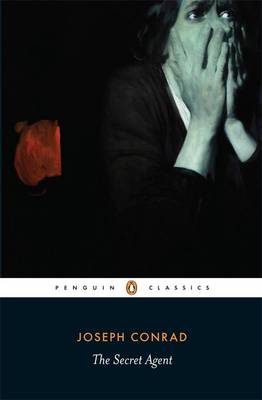
The Secret Agent
By Joseph Conrad
Edited with an Introduction by Michael Newton
Penguin Books, 2007
ISBN 978-0-141-44158-0

An acute analysis of the human condition may well conclude that behind the flim-flam of philosophy, theology, metaphysics and transcendental speculation, human actions, ideals and aspirations are conditioned by, and derived from, a corrosive Fear. A fear of reality translated into a hatred of existence reified as a culturally conditioned loathing of the world. Subjected to a process of ideological sublimation, this loathing, which is self-loathing, is transformed into extreme politics, a form of politics defined here, by Michael Newton in his Introduction, as ‘the politics of feeling’. The Secret Agent delves into the political unconscious of the politics of feeling.
It is very well known that just as Dostoyevsky based his political novel The Devils (1871) on the true life Nechayev Conspiracy of 1869, so Conrad, writing in 1906, based his fictional ‘dynamite novel’ on a political outrage as reported in the newspapers. Anarchist Martial Bourdin emerged from the shadows to die, horrifically, in a failed bomb-attack on The Greenwich Observatory in 1894. In this depressingly familiar case the perpetrator was killed by his own explosives, leading Conrad to ponder the implications of – to use his words – such an act of ‘blood stained inanity’.
Newton asks if the anarchist action was planned as an attack on the Meridian Line. Was it an attempt to destroy the organisation of time itself? For those fixated on the compulsive doctrine of the attentat, the notion of propaganda by deed, such an objective may have seemed entirely valid. The action of the novel centres upon the reactions of Mrs Verloc, whose retarded younger brother Stevie is inveigled into becoming the bomb-carrier by her shady husband, a double agent – the ‘Secret Agent’ of the title. Her death at the end of the book is reported in the press as ‘Suicide of Lady Passenger from A Cross-Channel Boat – An Impenetrable Mystery Seems Destined To Hang For Ever Over This Act Of Madness And Despair’.
It is the explanation of this ‘impenetrable mystery,’ the motivation for Mrs Verloc’s acts of murder and self-destruction, of madness and despair, that forms the domestic dimension of the plot. A plot inspired by a few words uttered by a friend, Ford Maddox Ford, who, in conversation, remarked “Oh that fellow was half an idiot. His sister committed suicide afterwards.” It was Conrad who expanded the scenario to include the murder of Mr Verloc by his wife, a desolate woman for whom the tragic Stevie, almost unearthly in the intensity of his compassion, meant everything.
If the scenario of The Secret Agent retains a morbid sense of familiarity (a vulnerable youth manoeuvred into committing an atrocity, or potential atrocity, by a trusted elder) then the most lurid of extremists, the ‘incorruptible’ Professor, the Perfect Anarchist, embodies Conrad’s conception of the ultimate terrorist. Even though the epithet recalls Robespierre, this is certainly a figure more familiar than we would like.
Two key scenes of the story are conversations set in a seedy hostelry called The Silenus (‘the renowned Silenus’) where, towards the end of the book, one of the subversives, comrade Alexander Ossipon, nick-named The Doctor, is discussing the Verloc Affair and its outcome. During this discussion The Professor taps the breast pocket of his jacket, claiming “And yet I am the force.”
Ossipon announces his future Brave New World of two hundred years into the future when ‘doctors will rule the world’ for, even now, in the shadows, ‘science reigns already’. He describes his vision to counteract the misanthropy of his companion who preaches ‘utter extermination’.
Aghast, Ossipon exclaims, “you carry in your pocket enough stuff to send yourself and, say, twenty other people into eternity.”
The Professor responds by raising his glass and drinks calmly to “the destruction of what is.”
To intimidate the authorities and so deter arrest this creature of hate has turned himself into a human bomb; he declares the sole aim of his life is to develop the perfect detonator – an intelligent detonator. In several paragraphs Conrad expounds the viewpoint of The Professor who feels that he is ‘a force’. A misanthrope who loathes the weak and ‘the odious multitude’ of mankind, he anticipates the death-doctrine of fascism: “I depend on death, which knows no restraint and cannot be attacked. My superiority is self-evident.” For an irritated Ossipon this is “a transcendental way of putting it.” The adjective is pejorative.
Joseph Conrad’s approach to his subject matter is one of relentless, consistent irony and it is this all-pervasive irony that, among other factors, makes The Secret Agent such a remarkable work of fiction, or, to quote Newton, a ‘signally important work of Modernist fiction.’ It should be noted that Conrad’s sardonic view is all encompassing and no one escapes his excoriation – not the radicals, not the politicians, not the police and not the ‘ordinary’ person for there are no ordinary people in this novel of ‘radical grotesques’.
In his Author’s Note (1920), included in this volume, Conrad remarks upon the ‘criminal futility’ of the Greenwich incident. He condemns all aspects of the attack including doctrine, action and the fundamental mentality. For him the most obnoxious feature of the radical pose is that it stems from a brazen desire to exploit ‘the poignant miseries and passionate credulities of a mankind always so tragically eager for self-destruction.’ It is this radical pose with its ‘unpardonable’ philosophical pretences that is represented in various ways by the menagerie of radical grotesques comprising the anarchist underground described in the novel.
This collection of repellent types includes not only The Professor and Comrade Ossipon but also other figures like Michaelis (possibly based on Kropotkin) and Karl Yundt (known as ‘the terrorist’) whose views are somewhat similar to those of the Incorruptible Professor, even though the latter despises the former. Yundt dreams of a cadre of ‘destroyers’, a band of men (they are all men, these committed idealists) ‘absolute in their resolve to discard all scruples in the choice of means’. Devoid of all pity for anything, including themselves, these ‘destroyers’ would enact the principle of ‘death enlisted for good and all in the service of humanity’.
As a ‘dynamite novel’, an example of the newly emerging genre of espionage fiction, The Secret Agent is also an urban novel. Elsewhere critics have written much on this aspect of a book, which remains one of the great London stories with its descriptions of Westminster, Soho and Kensington set in the fin-de-siecle era. Here the city is a suffocating, hellish domain. It functions as the sordid backdrop for acts of depravity perpetrated by fragmentary beings prone to the ludicrous outcomes ‘of chance and our own natures’ as Michael Newton explains, hapless victims of ontological ambush, of ‘unexpected solutions of continuity, sudden holes in space and time’ to cite Conrad himself.
Is this ‘totally ironic artefact’ also a novel which diminishes all human agents and the human civilisation of which they claim to be part, as is stated by Fletcher and Bradbury in their essay on The Introverted Novel. Perhaps, but even if agents of destruction pass ‘unsuspected and deadly, like a pest’ through our streets, as does The Incorruptible Professor at the end of the narrative, it is also another human agent, a clear-sighted writer, who has unmasked the unpardonable ‘philosophical pretences’ articulating the megalomania of Fear. Here, laid bare, is the murky pathology of all deluded ideologues seeking to regenerate a fallen world but who, in fact, are driven by a vitriolic hatred of existence.

published in The Supplement Issue 37 Nov 2007

Illustration: Water Lane, 1980

Tuesday, 1 March 2011

The Shadow Of The Uncanny

The longest period of human history is human prehistory – yet, generally speaking, the implications of this are not understood. Just as the greatest proportion of the sphere of the mind is a dark, undiscovered continent – the unconscious – so the greatest proportion of human experience, our pre-literate, pre-cultural history, is also a vast sphere of the unknown. All the phenomena of consciousness are infused with indirect, unconscious influences, similarly all the experiences and ‘achievements’ of mankind during the current, brief phase of evolution (‘history’) are rooted in an obscure and distant past. This past is inaccessible to us even though it overshadows every aspect of our daily existence. Like the microwave background radiation – the barely detectable evidence of the earliest cosmic era that permeates the present universe – vestigial traces of mankind’s earliest and most traumatic experiences permeate the contemporary actuality of being. We have become so adjusted to our present mode of psychical life that these vestiges have assumed the paraxial character of radical alterity. Their marginal presence is so tenuous and indefinite that we have never grasped their significance – that they constitute the weakest of evidence for the vacancy of collective amnesia, a yawning gap in the human time-line. Not so much a loss of memory but, perhaps, vestiges of inexplicable experiences endured during an era before the evolution of memory itself.
Picture the ‘space’ occupied by our fragile self-awareness bordered on two sides by gulfs of impenetrable darkness – on the one hand by an abyss of the distant past, on the other hand by the shadowlands of the mind.

Published in The Supplement Issue 22, 2005

Illustration: Echoes Of The Past, 2000

Saturday, 28 November 2009

Interview With Jane Marsh


Interview with Jane Marsh
Neon Highway On-line 2006
Edited by Alice Lenkiewicz
Hi A. C.
I would imagine you would appreciate this room. On the wall there are paintings by Klimt and Duchamp. My gramophone over there plays music by Liszt and Wagner.
The CD player plays music such as The Stones and The Velvet underground.
The weather is just wonderful. We are now in Mid winter so it is cold and icy outside. The trees are bare and there is some frost and ice on the ground.
On the bookshelf you may find some collections by Plath, Byron, Baudelaire and Swinburne. There are also two recent reviews of yours on Lee Harwood’s Chanson Dada. Selected Poems by Tristan Tzara and Symbolism by Rodolphe Rapetti. Now if you just seat yourself down I would like to ask you a few questions to someone whose writing style it seems has been described as ‘macabre, hermetic minimalism’.
1.
Your work has been around for a long time and first published in the British alternative press in 1977. However it has been said that your work was more driven towards " modern occultism" rather than the conventional ‘literary’ small press. Could you explain what it was that pulled you in this direction?
Gosh, Jane! You are looking very vampish this afternoon…. And you have gone to so much trouble. It is very much appreciated and very nice to talk… But, to answer your questions: My first ‘publication’ was, in fact, 1968 when I was lucky to land a tiny contract for greetings cards. A few designs were distributed through high street shops at the height of the ‘Beardsley craze’ during the Art Nouveau Revival… Also, under the umbrella of the Convulsionists, I managed to issue some mass-produced prints and get things into the school magazine. This was all in the late nineteen sixties. After a break I started submitting material to little magazines in the mid nineteen seventies, hence the reference to ‘alternative press….’. The first magazine to take some pictures was called Sothis. I soon found acceptance with other editors in the ‘occult’ scene. There were mags with titles like The Daath Papers, Illuminatus Monthly and Nox: A Magazine of The Abyss. I was instinctively drawn to this kind of subculture: it seemed more attuned to the disruptive, paraxial fantasy I was trying to achieve than the rather staid literary scene. In any case – despite my Aestheticism – I didn’t really see my work as a narrowly ‘artistic’ enterprise – like the Surrealists I was aiming at some kind of transformational paradigm outside mainstream definitions of art/poetry. There were clear affinities between Surrealism and ‘occultism’ (a vague, dodgy term I should say) and, at the time, one felt ‘occultists’ to be more ‘alternative’ than most exponents of the counter-culture who played at being hippies at weekends. The Surrealist ‘angle’ on the occult was, of course, non-mystical – unlike the Crowleyites, or the Alexandrians, for instance, I did not view the occult as an alternative religion. It was more to do with ‘reclaiming the imagination for anarchy and nihilism,’ formulating tactics to disconnect creativity from the hegemony of ‘the establishment’. Gothic Romanticism, Baudelaire’s ‘Satanism’ and Rimbaud’s use of alchemy provided historical parallels, while Jung’s psychology pointed to an ‘interior model’ for the ‘occult image’.
2.
Could you tell me a little about your work?
The work develops on two fronts: the written and the visual. Within these two spheres I operate on a narrow spectrum of formats. The written works fall into non-fiction and ‘literary’, the visual works are black and white line drawings in either pen or pencil, collages (mainly photomontages) and, more recently digital-photo images of various kinds. Regarding the literary work I would subdivide it into poetry/experimental prose, fiction (short stories) and poetry translations from the French. In both literary and visual work I often rely on automatism and chance elements. Automatism means a kind of immersion in the unconscious process, guided intuitively. I have often regarded ‘automatic’ line work as rather like calligraphy, hovering on the borderline between pictorial representation and writing. All artistic activity is supported by the non-fiction work ranging from short review notices to extensive feature-length articles/essays like Angels Of Rancid Glamour (1998). Baudelaire said artists should also be critics – it is vital to maintain a sense of focus and context, and to engage with the history of ideas.
3.
Who were the first presses to support you?
Well, apart from the occult ‘zines mentioned the first art-poetry press to support my work was Stride edited by Rupert Loydell. Throughout the nineteen eighties Stride maintained a policy of openness to diverse approaches that was – and still is – exemplary. Stride published my first small collection Exosphere in 1984 and I contributed reviews, artwork and poetry to the magazine. Today Stride is one of the best independent presses on the UK scene. I should also mention Phlebas and Tabor who published the mini collections Chimaera Obscura and Dream Vortex.4.
Can you tell me a little about your poem Space Opera?
Space Opera was short sequence of prose-poems first published in Stride’s Serendipity Caper anthology. It was subsequently re-issued as an illustrated booklet with an intro by Steve Sneyd. Written in a kind of techno-reportage style the sequence evoked a universe where there is no distinction between inner and outer space and all communication is subject to widespread disruption from indeterminate forces. The general setting was onboard a clapped-out star-ship on a mission to investigate the mysterious planet NeoGaea, a kind of parallel Earth, but millions of light years from home. It was an attempt to fuse lowbrow and highbrow by taking a simple space adventure scenario and filtering through a mannered poetic style – the cognoscenti define this sort of thing as ‘speculative poetry’…
5.
Your work has been described as ‘artistic’ meeting ‘magical’. What would you say is your driving influence?
That’s quite a ‘deep’ question, depending on what you mean by ‘influence’ – influences should be points of departure not destinations, I think. In the nineteenth century from the time of the French Revolution to the First World War one can see a progression of ‘movements’, often referred to as avant-garde – we learn from many figures and themes of those movements and define ‘influences’ that way. That’s a very big subject and the cultural history, from Baudelaire to Beauvoir, is very important. Formative influences (i.e. contemporary, not historical) included Dada/Surrealism, Op and Pop Art, Psychedelia and Nouveau Realisme (e.g. Tinguely) – that’s on the visual side. Contemporary literary influences included Burroughs, Borges, Nabokov, Pynchon, Angela Carter and J G Ballard. As I say this it is clear that none of these were poets in the strict sense, actually they are all prose writers. I had heard about the 1965 Albert Hall event but we didn’t really take much notice of the poetry scene – the era was defined by Mary Quant and Ossie Clark not the Children of Albion. My inspirational figures were Aubrey Beardsley, Antonin Artaud and Marcel Duchamp. I think we can return to this a bit later on when we talk about the Convulsionists because, amid this welter of references, I’m thinking about your phrase ‘driving influence’…. And Paul Meunier’s observation (quoted in Rapetti’s Symbolism) that ‘artistic concerns were originally alien to the production of art.’
6.
What kind of poetry or movements in poetry do you particularly dislike and why?
I have always been against any kind of literary theory that downplays or ignores the visceral basis of creativity. The creative imagination is driven by non-verbal, obsessive compulsions that, in the final analysis, are rooted in biological/genetic phenomena. It is obvious that creativity is value-neutral and independent of any particular form of expression, visual, literary or musical. Therefore, I have no positive interest in the kind of fashionable Post Modernism that locates the main theoretical focus of poetry in the domain of ‘language’. I see this trend and similar academic fashions (Social Constructionism or Reader Response Theory) as part of the regrettable inheritance of Wittgenstein – it is clearly reactionary. For example, the current oxymoronic notion of ‘linguistically innovative’ poetry is based, according to its luminaries, on doctrines of Ethical Criticism, specifically the writings of Levinas and Bakhtin. To begin with this is contradictory in that a truly ‘language-centred’ poetry cannot be based on an ethical framework of any kind. In the second place it is intrinsically reactionary as the writings of Levinas, Bakhtin, and the other gurus, are mainly propaganda for orthodoxy dressed-up in the ‘technical’ Newspeak of academia: ‘defamiliarisation’, ‘plurivocity’, ‘dialogism’ ‘sociolect’. The doublethink is the objectionable aspect – projecting a ‘progressive’ and ‘advanced’ image but working to a regressive, conservative agenda. It’s a question of cultural politics, not literary standards, because any art that is neither entertainment nor therapy is spin and propaganda – welcome to IngSoc! The Language Poets of the 1970s de-valued, even denied, the individual voice in the name of anti-Romanticism and in so doing allied themselves, knowingly or not, with the worst kind of literary Puritanism. I don’t really care if a given example of Language Poetry conforms to someone’s idea of ‘good’ poetry, in the end its only radical chic. I would say the same about the British Poetry Revival in its earlier phases: it was an amateur way of latching on to worthless American trends – Black Mountain, Objectivism, Projective Verse and all that frightful stuff. Actually, it was a publicity stunt to promote a generational revolt against the Georgians and – wassisname? – Larkin. They want to write Modern Epics – they take themselves far too seriously – give me Fiona Pitt-Kethley any day!
7.
To what extent has alchemy influenced your work?
The function of art is the transformation of substance into style.
8.
Tell me a little about your creative process.
The ‘creative process’ is a primitive, bio-psychic phenomenon characterised by the interaction of external stimuli, unconscious drives and the neural-endocrine levels of the biological system (physis). These interactions generate the ‘altered states’ intrinsic to creativity. Cultural factors determine how various features or facets of creativity are defined as ‘artistic’. The main impulse for any creative act takes the form of an obsessive compulsion or drive-demand, often referred to as ‘inspiration’: the production of a given work of art, and its dreamlike characteristics, can be explained from the psychoanalytic perspective. Composer Toru Takemitsu said his work 'Quotation of Dream' (1991) was ‘fragmental’ and episodic, reflecting the ‘shapes of dreams’. He observed that a work can be vivid in detail but may describe ‘an extremely ambiguous structure when viewed as a whole’. Following both Freud and Takemitsu, I would say that poetic form should resemble that of a dream where, for instance, details may be clearly defined while their disposition is determined by the ‘fortuities’ of a ‘self-propelling narrative’. For me the attraction of collage – and other modes of juxtaposition – derive from conformity with the Freudian ‘dream-work’ and the laws of the unconscious – the two main properties of dream-work being compression and displacement. The law of compression determines the fragmental and condensed format of all my work in any medium. The law of displacement encourages an allusive approach to ‘mood’ or ‘atmosphere’ akin to Mallarme’s adage ‘paint not the thing but the effect it produces’. Displacement of psychic intensities ensures that the least important features of the work are given more prominence than the most significant, leading (with luck) to a somewhat ‘hermetic’ or enigmatic effect…. I must add that chance plays a key role in everything…
9.
If you could go anywhere in reality that somehow was created from your imagination where would it be and what would it be like?
It might be like a neglected pleasure pier on the North Sea coast. During the day there would be howling gales and isolated rainstorms, at night the sea would be like purple glass – the moon would look huge. From the shore would float the distant, scratchy sound of an old 1940s Benny Goodman/Peggy Lee recording of ‘Blues in The Night’.
10.
You have said that Surrealism has been a strong influence in your work.
If you were to exhibit your work in a gallery these days what kind of show do you think you would focus on?
Dark Energy – Dark Energy comprises seventy percent of the universe and provides the repulsive force necessary to power the ever-accelerating expansion of the galaxies. Just as the existence of the unconscious can be inferred from Freudian Slips, so Dark Energy can be detected indirectly from the effects of virtual particles on the orbits of electrons. I like the idea that seventy percent of the universe is ‘dark’, just as seventy percent of the mind is ‘dark’ and seventy percent of human prehistory is ‘dark’. So my exhibition would be based around Three Zones Of Darkness. To the side there might be shrines dedicated to some modern goddesses: Veronica Lake, Caterina Valente, Julie London, Donyale Luna and P J Harvey. I think the décor would look rather like Martin Hibbert’s Burnt Out Hotel. Oh, I might exhibit some collages and drawings as well! At lunchtimes there would be tasteful piano recitals and in the evenings there would be poetry readings – in the dark, obviously…

11.
You say you enjoy the work of Louise Nevelson. I do also. I read a book about her work a while back and I was fascinated by her assemblages made from found objects and painted gold. I just thought I would mention that to you.
Yes! The Tate Gallery has a couple of her things. There was one called 'Black Wall' (1959) and another called 'American Tribute To The British People' (1960-1964). I thought the 'Black Wall' as fantastically sinister… There are Sky Cathedrals, Royal Games, Rain Gardens and Night Scapes, all very intricate and painted uniformly in either white, black or gold… there are echoes of Nevelson in some of my drawings…
12.
Can we build an assemblage together? I’ll collect a few objects and you put them together how you want. Here we are, some old boxes, feathers, a doll, picture frames, books, string, a glass case, medicine bottles, paper, broken mirror, pieces of rusty engine, glossy magazines, shoes, a mannequin, lots of old china plates and a few cans of spray paint. What do you reckon? I’ll come back in an hour and see what you produced.
OK, I have added an empty window frame and a battered wig-maker’s white polystyrene artificial head called ‘Ultima’ to this assemblage. ‘Ultima’ is an important totem. In the glass case will be several old sepia photos and the diary of a bibliomaniac. The broken mirror must be at the centre of the installation. You can just take a photo and add it here if you wish?
13.
Now I just want to show you the chamber. This is the deepest room in the house way below the ground and the steps are a little creaky. Hope you’re not too tired, it’s quite a way down.
Hope you like my spiral staircase. Here we are at last.
Please step inside. Okay please do sit down. You can use that old gravestone if you wish?
Jane, this is such a friendly way to conduct an interview – thank you, this gravestone is quite comfortable – what does the inscription say? I can’t quite make it out as it is covered in yellow and black lichen. What a gloriously spooky wrought iron spiral staircase that was – I can almost taste the rust.
Could you tell me about the group you formed called The Neo-Surrealist Convulsionist Group?
It is tempting to say we were just a group of alienated teenagers…! We formed the thing around 1968 and it only lasted until around 1971 or 1972. There were about five or six participants based in Chelmsford, Essex. Other places included Colchester, Ipswich and Witham… people used to meet in coffee bars after school – we were all sixth formers doing art or literature, mainly as a way of avoiding sport. The associations continued after everyone left school and tried to get jobs. Some poetry was written and experimental prose cut-up; atonal electronic music was composed and lots of paintings and collages produced. There were occasional expeditions or ‘pilgrimages’ to ‘displaced destinations’ such as the old Hungerford Bridge, the Victoria Embankment Gardens (for the Sullivan Memorial – very ‘convulsive’), The Atlantis Bookshop, or the Dashwood Mausoleum and Hell Fire Caves at West Wycombe. But mainly there was a lot of loafing around, drinking coffee and snogging – or going to see Hammer Horror films and German Expressionist movies at the NFT. There was one exhibition at Hylands House – the exhibition was for all the school leavers but we managed to commandeer a room – as the Convulsionists were the general organisers of the show it was quite easy to get the space! We came up with the term ‘Convulsionism’ after the phrase ‘Beauty will be convulsive…’ (from Breton’s Amour Fou). I felt it implied the ‘visceral’ idea - my ideal work of art was to be a meaningless allegory generated by a kind of neurological spasm or frisson that could be transmitted to the viewer – well, if it gave me a frisson it might give you one as well. One old policy document from my archive says: "CONVULSION IS CONCERNED WITH THE BEAUTY OF PURE IMAGINATION AND FANTASY AND IS VIOLENTLY OPPOSED TO CONTRAPTON IN ANY FORM" (Convulsively Produced Notes On Convulsion, 1968). Earlier, I mentioned some key influences… I should add the Lost Generation to the list – the Francophile ‘Yellow Nineties’ Decadent poets and artists (Arthur Symons, Ernest Dowson et al) and, also, the ultra-Symbolist absurdism (as we saw it) of Laforgue and Alfred Jarry – we were quite keen on ‘Pataphysics as I recall… There was some empathy with English Pop Art, so we rather revelled in the Mass Media – Pop Music (The Doors, Brian Auger), Jazz (Indo Jazz Fusions, Duke Ellington, Charles Mingus), Science Fiction and ‘cult TV’. It was ironic that the real Surrealists disbanded in 1969 (Andre Breton died in 1966) so we settled for being Neo-Surrealists!
14
What are you working on at present?
I am continually revising my ‘personal aesthetic’ (which is not a literary ‘poetic’) and have found this has absorbed much of my time in recent months. In our present situation when, for various reasons, free artistic expression is coming under threat as never before, I have been driven to ‘sharpen up’ my thoughts on such issues… On a more practical level I am revising and digitizing some non-fiction from the back-catalogue – various reviews and articles that I feel I have neglected and must revisit. I have an ongoing programme of computerisation that is quite time-consuming – some examples appear on the Tangents website. Publication-wise there are various poems accepted by magazines including Fire. Recent appearances have included ‘Vespula Vanishes’ a poem for Tori Amos (Inclement), ‘Danger (Midnight Street)’ (Pulsar), ‘Beautiful Chaos’ and ‘Dadar Radar’ (Fragments), and another piece called ‘Not The Cloudy Sky’ (Harlequin). Forthcoming, among other items, is a short story ‘Vikki Verso’ from Atlantean Publications who have taken a number of texts and drawings over the last couple of years. A recent collage, called ‘In the Beginning’ is on the cover (designed by Neil Annat) of a new Stride publication – Peter Redgrove’s A Speaker For The Silver Goddess (2006).
Thank you for answering my questions A.C.
And, thank you, Jane, for a fascinating conversation…
I’ll go and get you a glass of wine from the cellar
Be careful how you go – mind all those cobwebs!
I wish you luck and fortune with your work, as Salomon Trismosin once said:
Study what thou art
Whereof thou art a part.
What thou knowest of this Art,
This is really what thou art,
All that is without thee,
Also is within
All best for now.
Jane

Neon Highway, 2006